|
所在平台: Coursera |
课程主页: https://www.coursera.org/learn/molecular-evolution
课程评论:没有评论
课程名称:分子进化(生物信息学 IV) 概述:在上一个专题课程中,我们学习了如何比较基因、蛋白质和基因组。一种应用这些方法的方式是构建“生命之树”,展示一大组相关生物体如何随着时间的推移而演化。本课程的前半部分,我们将讨论一些历史上被引用最多的科学论文中的进化树构建方法,以及这些方法如何帮助解决从致命病毒的起源到现代人类的出生地等问题。 课程后半部分,我们将转向考察鸟类是否真的起源于恐龙的旧说法,以及如何证明这一点。我们将特别分析一项研究,该研究声称从恐龙化石中提取的肽与鸡中发现的肽密切匹配。我们将运用计算蛋白质组学的方法评估这一结果的真实性,或者说其是否受到某种污染的影响。 最后,您将学习如何使用流行的生物信息学软件工具,重建埃博拉病毒的进化树,并识别造成全球头条新闻的最近埃博拉疫情的来源。 课程大纲: - 第1周:进化树构建简介 - 介绍如何使用计算方法解决生物学问题,包括“哪个动物给我们带来了SARS?”和“霸王龙是不是大鸡?”等议题。 - 第2周:基于距离矩阵构建树的更多算法 - 学习如何使用邻接-连接算法等方法从距离矩阵构建进化树。 - 第3周:基于性状构建进化树 - 了解如何使用“性状”而非距离来构建进化树,并推断生物体在进化树中的祖先状态。 - 第4周:鸟类是否起源于恐龙? - 分析分子证据支持该理论,并探讨恐龙与现代鸟类之间的相似性。 - 第5周:解决T. rex肽之谜 - 讨论恐龙肽在化石中存活6500万年的可能性,并使用统计学分析其有效性。 - 第6周:生物信息学应用挑战 - 通过重建埃博拉病毒的进化树,确定造成非洲近期疫情的病原体的起源。 课程通过幽默的生物信息学漫画增添趣味,帮助学生在学习的同时获取相关知识。想知道棘虫和蝙蝠与致命病毒有何关系?今天就开始学习,找到答案吧!
Name:Week 1: Introduction to Evolutionary Tree Construction
Description:
Welcome to our class!
In this class, we will consider the following two central biological questions (the computational approaches needed to solve them are shown in parentheses):
In Week 6, you will complete a Bioinformatics Application Challenge to apply evolutionary tree construction algorithms in order to determine the origin of the recent ebola outbreak in Africa.
As in previous courses, each of these two chapters is accompanied by a Bioinformatics Cartoon created by talented artist Randall Christopher and serving as a chapter header in the Specialization's bestselling print companion. You can find the first chapter's cartoon at the bottom of this message. What do stick bugs and bats have to do with deadly viruses? And how can bioinformatics be used to stop these viruses in their tracks? Start learning today and find out!

Name:Week 2: More Algorithms for Constructing Trees from Distance Matrices
Description:
Welcome to Week 2 of class!
Last week, we started to see how evolutionary trees can be constructed from distance matrices. This week, we will encounter additional algorithms for this purpose, including the neighbor-joining algorithm, which has become one of the top-ten most cited papers in all of science since its introduction three decades ago.
Name:Week 3: Constructing Evolutionary Trees from Characters
Description:
Welcome to week 3 of class!
Over the last two weeks, we have seen several different algorithms for constructing evolutionary trees from distance matrices.
This week, we will conclude the current chapter by considering what happens if we use properties called "characters" instead of distances. We will also see how to infer the ancestral states of organisms in an evolutionary tree, and consider whether it is possible to define an efficient algorithm for this task.
Name:Week 4
Description:
Welcome to week 4 of the class!
Did birds evolve from dinosaurs? Over the next two weeks, we will see how we could analyze molecular evidence in support of this theory. You can find this week's Bioinformatics Cartoon from Randall Christopher at the bottom of this E-mail. Why does the T. rex look so much like a chicken? And why is the monkey typing frantically? Keep learning to find out!
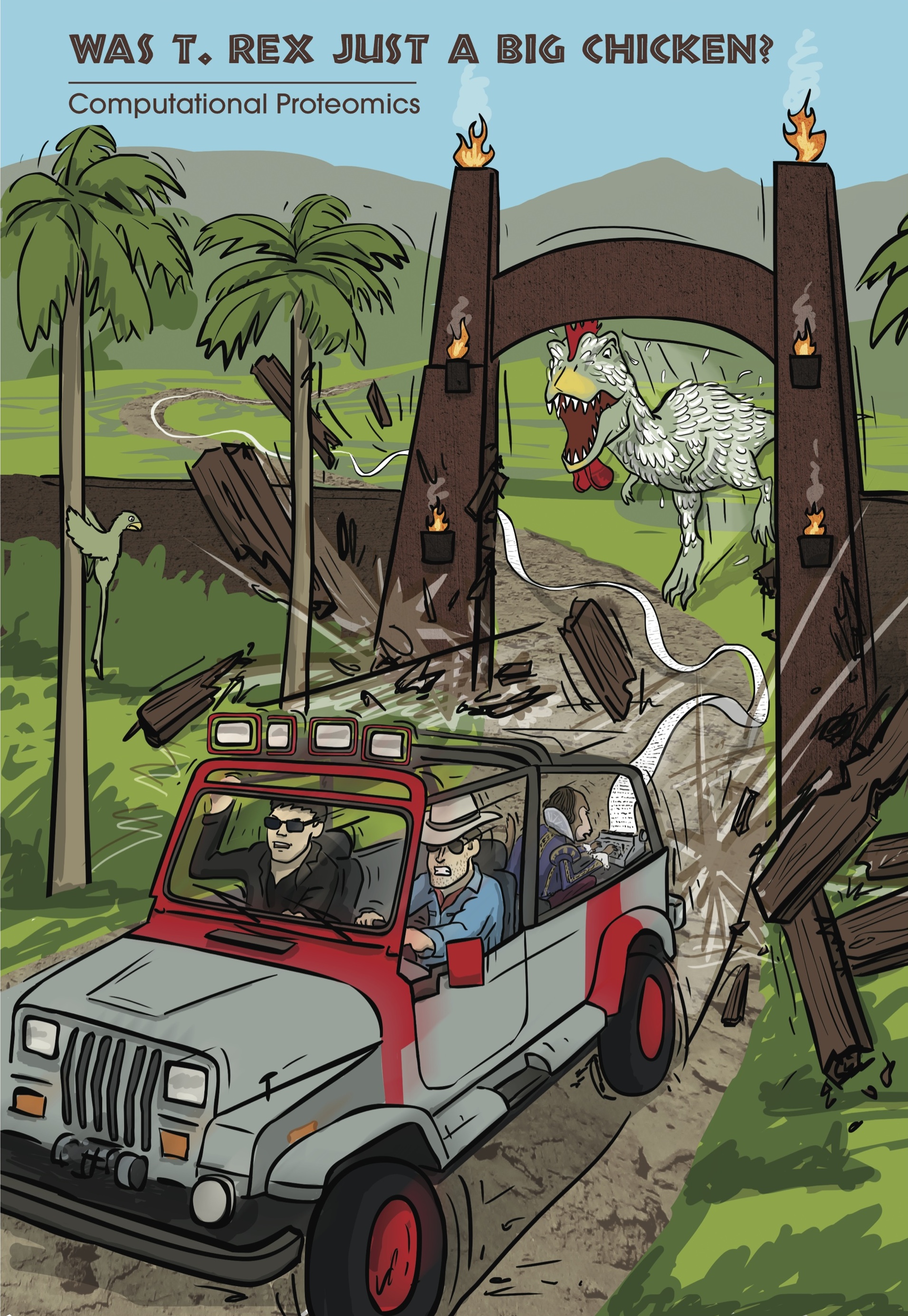
Name:Week 5: Resolving the T. rex Peptides Mystery?
Description:
Welcome to week 5 of class!
Last week, we asked whether it is possible for dinosaur peptides to survive locked inside of a fossil for 65 million years. This week, we will see what this question has to do with statistics; in the process, we will see how a monkey typing out symbols on a typewriter can be used to address it.
Name:Week 6: Bioinformatics Application Challenge
Description:
Welcome to the sixth and final week of the course!
In this week's Bioinformatics Application Challenge, we will use reconstruct an evolutionary tree of ebolaviruses and use it to determine the origin of the pathogen that caused the recent outbreak in Africa.
In the previous course in the Specialization, we learned how to compare genes, proteins, and genomes. One way we can use these methods is in order to construct a "Tree of Life" showing how a large collection of related organisms have evolved over time. In the first half of the course, we will discuss approaches for evolutionary tree construction that have been the subject of some of the most cited scientific papers of all time, and show how they can resolve quandaries from finding the origin of a deadly virus to locating the birthplace of modern humans. In the second half of the course, we will shift gears and examine the old claim that birds evolved from dinosaurs. How can we prove this? In particular, we will examine a result that claimed that peptides harvested from a T. rex fossil closely matched peptides found in chickens. In particular, we will use methods from computational proteomics to ask how we could assess whether this result is valid or due to some form of contamination. Finally, you will learn how to apply popular bioinformatics software tools to reconstruct an evolutionary tree of ebolaviruses and identify the source of the recent Ebola epidemic that caused global headlines.
